











Why is the sewing process of high-temperature filter bags more durable than ordinary sewing with three needles and six threads?
May 23,2026
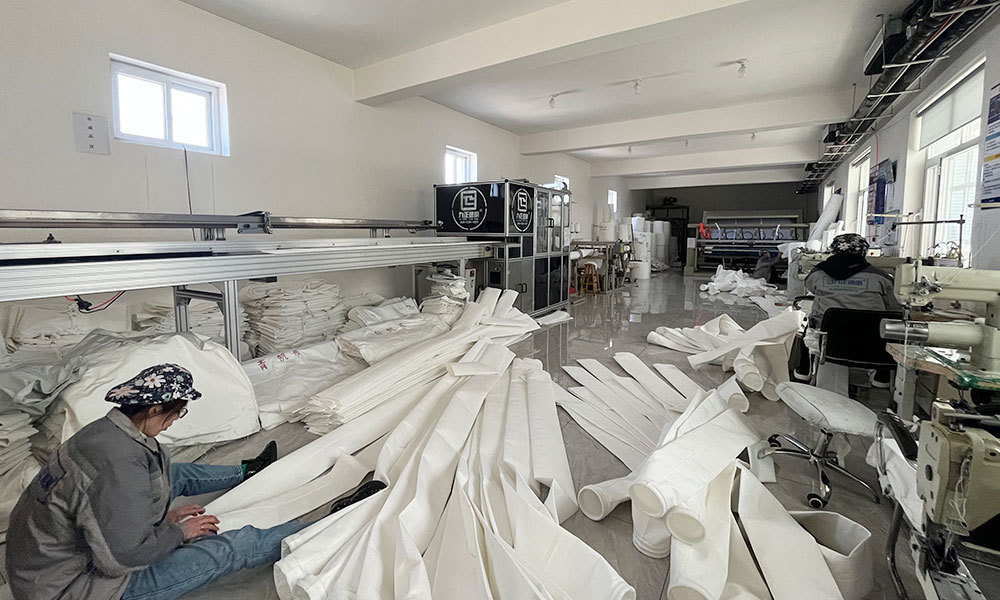
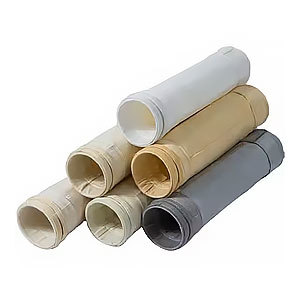
In the field of industrial dust removal, many customers tend to focus on filter materials such as PTFE, PPS, or fiberglass when choosing high-temperature filter bags, but easily overlook a crucial detail - the sewing process. For filter bags that are often several meters long and work in high-temperature and high-pressure environments for a long time, stitching is their "skeleton". If the sewing process is not up to standard, even if the highest quality filter material is used, the entire filter bag may be scrapped due to a crack in one seam. Today, let's delve into the mainstream "three needle six thread" sewing process for high-end filter bags, and why it is more durable than ordinary sewing.
1、 What is the three needle six thread suture technique?
Traditional ordinary sewing usually uses single needle single thread or double needle double thread methods, which have relatively limited strength and sealing at the seams. And 'three needles and six threads' is a more precise heavy-duty chain sewing technique. As the name suggests, it punctures the filter material simultaneously with three machine needles, combined with multiple sets of curved and straight needles, interweaving to form six tight stitches. This process forms a reinforcing strip approximately 8-12 millimeters wide at the longitudinal seam of the filter bag, which not only has straight lines and uniform needle spacing, but also has an extremely stable structure.
2、 Core Advantage: Why is it more durable?
Compared to ordinary sewing, the three needle six thread process exhibits three significant advantages in dealing with harsh working conditions:
1. Excellent tensile and fatigue strength: High temperature filter bags undergo frequent and severe expansion and contraction during the pulse cleaning process. The three-dimensional network stitch formed by three needles and six threads can evenly distribute the huge impact force during dust cleaning to the entire sewing surface, effectively avoiding stress concentration. Even under high-frequency vibration or strong airflow erosion, the joint can still remain tight and firm, and is not prone to breakage or breakage.
2. Ultimate sealing and leak proof performance: The pinholes left by ordinary sewing are large and sparsely distributed, and fine dust is easily penetrated and leaked from the needle holes. The needle spacing of the three needle six thread process is very fine, and multiple threads overlap and interlock with each other, greatly compressing the pinhole gap. This not only greatly improves the filtration accuracy, but also effectively eliminates the risk of dust leakage directly from the stitching.
3. Excellent wear resistance and heat creep resistance: High end three needle six thread technology is usually paired with high-performance sewing thread. Due to the high density of stitching, the contact area between the stitching and the filter material is larger, resulting in stronger adhesion and effective resistance to the continuous wear of the stitching caused by dust. At the same time, this tight structure can better adapt to thermal expansion and contraction in high temperature environments, preventing joint relaxation caused by material deformation.
3、 Craftsmanship details determine success or failure
Of course, a perfect stitching technique depends not only on the reputation of "three needles and six threads", but also on the adherence to standards. High quality filter bags will strictly control the needle spacing during production to ensure that there are no jumping needles, floating threads, or falling paths. At the same time, additional reinforcement treatment will be carried out on the most complex and easily worn key parts of the filter bag, such as the bag mouth and bag bottom, in addition to the three needle six thread foundation, to comprehensively ensure the overall life of the filter bag.
The sewing process of filter bags, although unremarkable, is a key intrinsic quality that ensures the long-term stable operation of dust removal systems and achieves ultra-low emissions. The three needle six thread process, with its high-strength physical structure and tight leak proof design, has become the "standard" for high-end high-temperature filter bags. Next time when evaluating the dust removal plan, it may be worth paying more attention to the "needle and thread work" on the back of the filter bag, which is often an important criterion for judging whether a filter bag is truly durable.
Hot Tags:
PREVIOUS:
Contact Us
Tel:
WeChat:
WhatsApp:
E-mail:
Address:
338 National Road South, Longfengdian Village, Botou City, Hebei Province, China
JiuznTomine is expertly delivering technically complicated projects in markets & provides custom solutions for their customized need.


CONTACT INFO
Tel: +86 18531710311
WeChat: +86-18531710311
338 National Road South, Longfengdian Village, Botou City, Hebei Province, China