












Selection guide for star shaped unloaders corresponding to different types of dust
Mar 21,2026

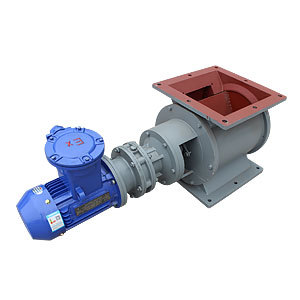
In foreign trade industrial scenarios such as dust removal systems and pneumatic conveying, the star shaped unloader is a key component that connects dust removal equipment with the conveying process. It is mainly responsible for uniform discharge, air lock sealing, and its selection directly determines the operational stability, sealing performance, and service life of the entire system. Unlike general equipment selection, the core adaptation basis of star shaped unloaders is dust characteristics. Choosing the wrong model can easily lead to problems such as material jamming, air leakage, rapid wear, and seal failure.
1、 Before selecting, clarify the three basic judgment dimensions
Regardless of the type of dust, it is necessary to lock in the basic parameters before selecting, as a prerequisite for subsequent classification matching, to avoid selection errors caused by parameter deviations:
1. Unloading volume: Calculate the unloading volume/weight per unit time, determine the number of rotations and impeller specifications of the unloader;
2. Work pressure/negative pressure: distinguish between normal pressure, positive pressure, and negative pressure working conditions, and select a sealing structure (ordinary seal/high pressure seal);
3. Operating temperature: Temperature resistant materials that match the shell, impeller, and seals, suitable for high/normal temperature conditions.
2、 Accurate selection scheme for different types of dust
1. Dry fine dust (flour, cement, silica fume, coal powder)
This type of dust has small particle size, good fluidity, and is prone to dust and air leakage problems. The core requirement is strong sealing and uniform discharge.
1. Selection recommendation: Choose a regular pressure resistant star shaped unloader, equipped with an adjustable clearance impeller, and control the clearance between the shell and the impeller within a reasonable range; Priority should be given to using cast iron material, and nitrile rubber should be used as the sealing element to meet the air lock requirements at room temperature and pressure; The rotation speed should not be too high to prevent dust splashing.
2. Key points for avoiding pitfalls: Avoid excessive gaps, otherwise air leakage may occur under negative pressure conditions, leading to a decrease in dust removal efficiency.
2. Coarse grained/abrasive dust (slag, sand and gravel, metal dust, coke powder)
Dust has high hardness and sharp edges, which cause strong erosion and wear on equipment. The core requirement is high wear resistance and impact resistance.
1. Selection recommendation: Choose a wear-resistant reinforced unloader, with the impeller surface treated with wear-resistant welding and embedded with wear-resistant lining plates, and the shell made of thickened carbon steel or wear-resistant cast iron; Increase the curvature of the impeller to reduce material impact and jamming; Can be paired with a variable frequency motor to adjust the speed according to the cutting amount and reduce the wear rate.
2. Key points for avoiding pitfalls: It is forbidden to use ordinary lightweight models, otherwise the impeller and shell will wear through and leak materials in the short term.
3. Viscous/deliquescent dust (sludge dust, hygroscopic salt powder, coating dust)
Dust is prone to moisture absorption, agglomeration, and adhesion to the impeller and inner wall of the casing, leading to material blockage and inability to rotate. The core requirement is anti sticking and easy cleaning.
1. Selection recommendation: Choose a direct connected anti sticking unloader, cancel the chain drive to avoid material jamming; The impeller is made of polished stainless steel material (304/316) to reduce dust adhesion; Can be equipped with scraper device and insulation jacket to prevent dust condensation and plate formation; The sealing components are made of oil resistant and adhesive resistant materials to avoid adhesive failure.
2. Key points for avoiding pitfalls: Avoid using ordinary cast iron impellers, as they are prone to material accumulation and clumping, which can cause motor overload.
4. High temperature dust (high temperature flue gas dust, metallurgical waste powder)
Dust carries high temperatures, and ordinary seals and materials are prone to deformation and aging. The core requirements are high temperature resistance and thermal stability.
1. Selection recommendation: Choose a high-temperature specialized unloader, with a cast steel shell and heat-resistant steel impeller; Replace the sealing components with fluororubber and graphite seals, which can withstand high temperatures above 200 ℃; Increase the gap between the shell and impeller, reserve space for thermal expansion, and prevent high temperature jamming.
2. Key points for avoiding pitfalls: It is strictly prohibited to use rubber seals at room temperature, as they will quickly melt and fail at high temperatures.
5. Corrosive dust (chemical dust, acid alkali salt dust)
Dust contains acidic and alkaline corrosive media, which can corrode the shell and impeller. The core requirement is corrosion resistance and aging resistance.
1. Selection recommendation: Choose an anti-corrosion unloader, and use carbon steel spray coating and rubber lining treatment for weak corrosion conditions; Directly select 304/316 stainless steel as the full material for strong corrosion conditions; The sealing element is made of polytetrafluoroethylene (PTFE) material, which can resist acid and alkali corrosion and extend the cross-border service life of the equipment.
3、 Additional considerations for foreign trade selection
1. Unified unit standards: When connecting with overseas customers, synchronously annotate metric and imperial parameters to avoid errors in size and flow conversion;
2. Adaptation installation specifications: Customize motors and interfaces based on the target market installation space and motor voltage (such as 460V in Europe and America, 380V in Southeast Asia);
3. Structural adaptation scenario: Rainproof covers should be installed for outdoor working conditions, and explosion-proof motors and anti-static impellers should be selected for explosion-proof areas.
Selection core summary: There is no universal model for star shaped unloaders, and everything is based on dust characteristics - fine dust grabbing sealing, abrasive dust grabbing wear-resistant, sticky dust grabbing anti blocking, high-temperature dust grabbing temperature resistance, corrosive dust grabbing anti-corrosion. Combined with basic working condition parameters matching, it can ensure stable operation of the system.
Hot Tags:
Contact Us
Tel:
WeChat:
WhatsApp:
E-mail:
Address:
338 National Road South, Longfengdian Village, Botou City, Hebei Province, China
JiuznTomine is expertly delivering technically complicated projects in markets & provides custom solutions for their customized need.


CONTACT INFO
Tel: +86 18531710311
WeChat: +86-18531710311
338 National Road South, Longfengdian Village, Botou City, Hebei Province, China