












Cleaning and preventive measures for blockage of spray tower
Jan 28,2026
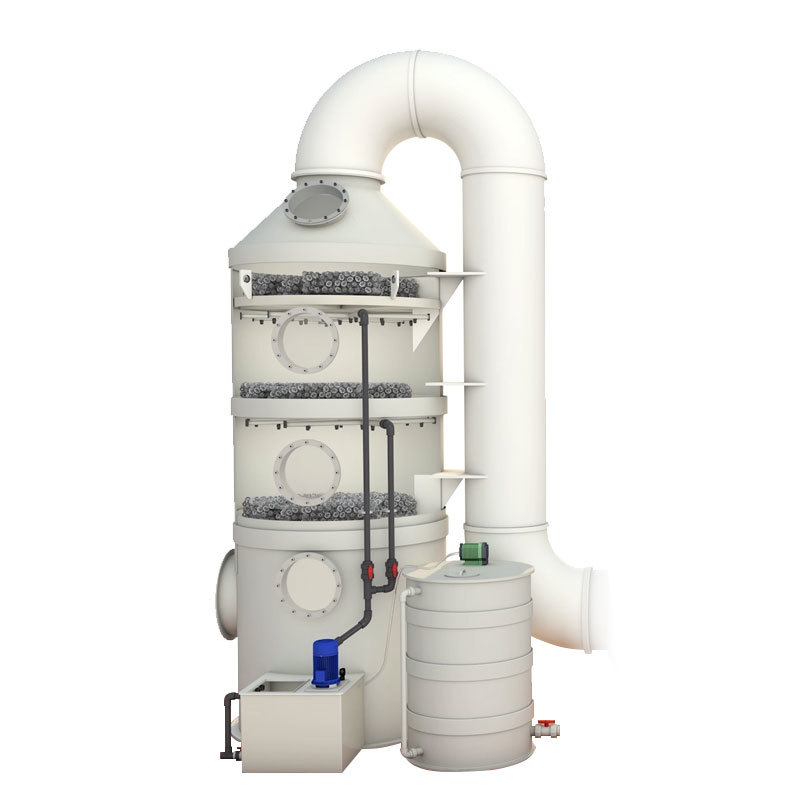
As a commonly used equipment for industrial waste gas purification, spray towers are widely used in the treatment of acid and alkali waste gases, dust and waste gases in industries such as chemical, metallurgical, coating, and pharmaceutical industries due to their simple structure and stable purification efficiency. However, in long-term operation, due to factors such as exhaust gas composition, spray medium, and operating parameters, the spray head, pipeline, packing layer, and sedimentation tank are prone to blockage, resulting in uneven spraying, decreased gas-liquid contact efficiency, and in severe cases, equipment shutdown, affecting production continuity and waste gas treatment effectiveness.
1、 Common blockage locations and causes of spray towers
The core cause of blockage in the spray tower is the accumulation of impurities and the reaction crystallization of the medium. There are differences in the causes of blockage in different parts, which need to be accurately located and treated accordingly.
(1) Core blockage location and causes
1. Spray nozzle blockage: The most common blockage is caused by the accumulation of dust particles in the exhaust gas and impurities in the spray solution. Especially when the water quality of the spray solution is poor and the dust concentration exceeds the standard, impurities are prone to adhere to the nozzle aperture, gradually reducing the flow area until it is completely blocked, resulting in insufficient spray coverage.
2. Blockage of sprinkler pipeline: The inner wall of the pipeline is prone to the deposition of dust and chemical crystals. If the slope design of the pipeline is unreasonable and the flow rate is too low, impurities will slowly accumulate, especially at the bends and joints of the pipeline, which can easily form local blockages and affect the distribution of sprinkler pressure and flow rate.
3. Blockage of packing layer: The surface of the packing is prone to adsorb viscous impurities, dust, and reaction products in the exhaust gas. Long term accumulation can block the gaps between the packing materials, leading to a surge in airflow resistance, a significant decrease in gas-liquid contact efficiency, and even causing liquid flooding.
4. Blockage of sedimentation tank: During the process of spraying liquid circulation, dust and reaction residue will deposit at the bottom of the sedimentation tank. If not cleaned in time, the sediment will gradually thicken, blocking the inlet and pipeline of the circulating water pump and affecting the circulation efficiency of the spraying liquid.
2、 Targeted blockage cleaning method
The cleaning work should follow the principle of "stopping for inspection first, handling in different locations, and protecting throughout the process", and choose physical or chemical cleaning methods according to the degree of blockage to avoid damaging equipment components.
(1) Spray head cleaning
1. Disassembly and inspection: After stopping the machine, close the spray system valve, disassemble the spray heads on the spray pipeline, check the blockage of the aperture one by one, and classify and handle it according to the degree of blockage.
2. Physical cleaning: For minor blockages, high-pressure water guns can be used for reverse flushing, or fine steel wires or needles can be used to clear the aperture and remove surface impurities; For sprinkler heads with severe blockage or aperture wear and deformation, replace them with products of the same model directly to ensure that the spray angle and flow rate meet the standards.
3. Cleaning and resetting: Rinse the cleaned sprinkler head with clean water, check the integrity of the seals, reset and install them in the order of disassembly, and conduct pressure testing after installation to ensure no leakage and even spraying.
(2) Spray pipe cleaning
1. Segmented investigation: Monitor the pressure distribution of the pipeline through a pressure gauge. The section with abnormally high pressure is the key area for blockage. Mark it and dismantle the pipeline in sections.
2. Cleaning method: For dust accumulation blockages, high-pressure air gun blowing combined with manual wiping is used to clean the inner wall of the pipeline; For chemical crystallization and scale blockage, chemical immersion method can be used - a targeted descaling agent can be prepared to immerse the pipeline section until the crystallization is completely dissolved, and then rinse it with clean water.
3. Pipeline optimization: After cleaning, check the corrosion and wear of the inner wall of the pipeline, and repair damaged parts in a timely manner; Adjust the slope of the pipeline (recommended not less than 3 ‰) to ensure smooth flow of the spray liquid and reduce the deposition of impurities.
(3) Cleaning of filling layer
1. Mild blockage: If the gap between the fillers is only partially blocked and the resistance does not increase significantly, the surface adhesion impurities can be cleaned by increasing the spray flow rate, extending the flushing time, and using the water flow impact force; The backwash system can also be activated to backwash the packing layer.
2. Moderate to severe blockage: It is necessary to dismantle the tower cover plate, remove the packing, and clean it in batches. For non viscous impurities, manual screening and high-pressure water gun flushing are used; For viscous impurities or crystals, the filler can be soaked in a specialized cleaning agent, and after the impurities dissolve, rinsed and dried. Remove damaged and deformed fillers during the cleaning process, add new fillers of the same specifications, ensure that the filler layer is evenly laid, and avoid gaps.
3. Reset check: After resetting the packing, check the stability of the packing support structure, start the equipment for no-load operation, monitor the airflow resistance, and ensure that it returns to the design range.
(4) Cleaning of sedimentation tank
1. Pre treatment: Turn off the circulating water pump, discharge the spray liquid from the sedimentation tank to the reserved tank, and retain a small amount of liquid for cleaning sediment.
2. Sediment cleaning: The sediment at the bottom of the pool is cleaned by manual shovel transportation and high-pressure water gun flushing. The focus is on cleaning the accumulated material at the water pump inlet and pipeline interface to avoid residual impurities from clogging again after cleaning.
3. Cleaning of the tank body: After cleaning, rinse the inner wall of the sedimentation tank with clean water, check whether the anti-corrosion layer of the tank body is damaged, and repair the damaged parts in a timely manner to prevent impurities from falling off due to corrosion. Finally, inject new spray solution and start the circulation system for trial operation.
3、 Preventive measures for full process blockage
Blockage prevention requires a combination of equipment design, operation management, and daily maintenance to reduce the entry and accumulation of impurities from the source and lower the incidence of blockages.
(1) Optimize front-end preprocessing
1. Waste gas pretreatment: Install a pretreatment device at the inlet of the spray tower to remove large particles of dust from the waste gas, especially for high dust concentration waste gas. The pretreatment efficiency should reach over 80% to reduce dust entering the interior of the spray tower.
2. Spray liquid pretreatment: The spray liquid needs to be filtered and equipped with precision filters to remove impurities and suspended solids from the water; Regularly check the water quality of the spray solution to avoid crystallization caused by high concentration of chemicals, replenish fresh solution in a timely manner, and replace aged spray solution.
(2) Optimize operational parameters
1. Control the spray flow rate and pressure: dynamically adjust the spray flow rate and pressure according to the exhaust gas treatment capacity and concentration to ensure that the spray head is in the best working state, avoiding impurities deposition caused by low flow rate and equipment overload caused by high flow rate.
2. Stable medication ratio: Strictly calculate the dosage of medication according to the composition of the exhaust gas, control the pH value of the spray solution, and avoid excessive medication causing crystallization reactions; Regularly mix and spray the solution to prevent chemical precipitation.
3. Maintain pipeline flow rate: Ensure that the liquid flow rate in the spray pipeline is not less than 1.5m/s to reduce impurity deposition; Regularly open the pipeline drain valve to discharge the sediment impurities inside the pipeline.
(3) Strengthen daily maintenance management
1. Regular inspection and monitoring: Establish a daily inspection system to monitor parameters such as inlet and outlet pressure, spray flow rate, and airflow resistance of the spray tower. If abnormal pressure increases or flow decreases are found, promptly identify potential blockages; Check the sprinkler head and pipeline interface for impurities attached every week and clean them in advance.
2. Regular cleaning and maintenance: Develop a periodic cleaning plan - the sprinkler head should be disassembled and cleaned every 1-2 months, the pipeline should be cleaned in sections every 3-6 months, the filling layer should be inspected and cleaned every 6-12 months, and the sedimentation tank should be cleaned every month. The specific cycle can be adjusted according to the intensity of the working conditions.
3. Replacement of vulnerable parts: Regularly inspect vulnerable parts such as sprinkler heads, filter cartridges, seals, etc. If wear or aging is found, replace them in a timely manner to avoid uneven spraying and impurity leakage caused by component damage.
(4) Equipment structure optimization
1. Spray head selection: Choose a large aperture, anti clogging spray head, and prioritize styles with good atomization effect and less slag accumulation to reduce impurity adhesion.
2. Pipeline and sedimentation tank design: The spray pipeline adopts corrosion-resistant and smooth inner wall materials to reduce the adhesion of impurities; The sedimentation tank is equipped with a slope and a discharge outlet to facilitate the collection and discharge of sediment. At the same time, a level gauge and a discharge valve are installed to facilitate monitoring and cleaning.
3. Add auxiliary devices: Install a filter screen type filter at the inlet of the circulating water pump to intercept impurities twice; Large spray towers can be equipped with automatic backwashing systems to regularly backwash the spray heads and packing layers to prevent blockages.
4、 Precautions
1. Safety protection: Before cleaning operations, the power supply of the equipment should be cut off, and warning signs should be hung up; For operations involving acid-base sprays and chemical cleaning agents, protective gloves, goggles, and protective clothing should be worn to avoid corrosion injuries; Internal operations within the tower must ensure good ventilation to prevent oxygen deficiency or the accumulation of toxic gases.
2. Avoid secondary damage: During the cleaning process, it is prohibited to use sharp tools to strike the sprinkler head, pipes, fillers, and other components to prevent damage to the equipment; When conducting chemical cleaning, it is necessary to choose a cleaning agent that is compatible with the equipment material to avoid corrosion of the tower body and pipelines.
3. Trial operation acceptance: After cleaning is completed, start the equipment and run it without load for 30 minutes to check for spray uniformity, pressure stability, and leakage. Then, introduce exhaust gas and run it at full load to monitor purification efficiency and equipment parameters. Normal production can only be carried out after meeting the standards.
In summary, the governance of blockage problems in spray towers should adhere to the principle of "prevention first, cleaning as a supplement", and reduce the risk of blockage from the source through front-end pretreatment optimization, operation parameter regulation, and daily refined maintenance; For the blockage that has occurred, it is necessary to accurately locate the location, select appropriate cleaning methods, and quickly restore equipment operation. Scientific operation and maintenance management can not only reduce downtime caused by blockages, but also extend the service life of equipment, ensure stable and compliant exhaust gas treatment efficiency, and meet the needs of green and efficient industrial production.
Hot Tags:


Contact Us
Tel:
WeChat:
WhatsApp:
E-mail:
Address:
338 National Road South, Longfengdian Village, Botou City, Hebei Province, China
JiuznTomine is expertly delivering technically complicated projects in markets & provides custom solutions for their customized need.


CONTACT INFO
Tel: +86 18531710311
WeChat: +86-18531710311
338 National Road South, Longfengdian Village, Botou City, Hebei Province, China