











Maintenance and upkeep of barbed wire and guarantee of long-term stable operation of electrostatic precipitator
Jan 14,2026

In the field of industrial flue gas purification, electrostatic precipitators (ESP) have become the core environmental protection equipment in industries such as power, metallurgy, building materials, and chemical industry due to their high dust removal efficiency, large processing air volume, and low operating costs. As the core component of the cathode system of electrostatic precipitators, the performance status of the barbed wire directly determines the electric field strength, dust charging efficiency, and overall dust removal effect. High quality barbed wire has the advantages of good volt ampere characteristics, strong adaptability to changes in dust specific resistance, and low corona voltage. Scientific maintenance is the key to ensuring its continuous effectiveness and ensuring the long-term stable operation of electrostatic precipitators.
1、 The core role and maintenance necessity of filigree thread
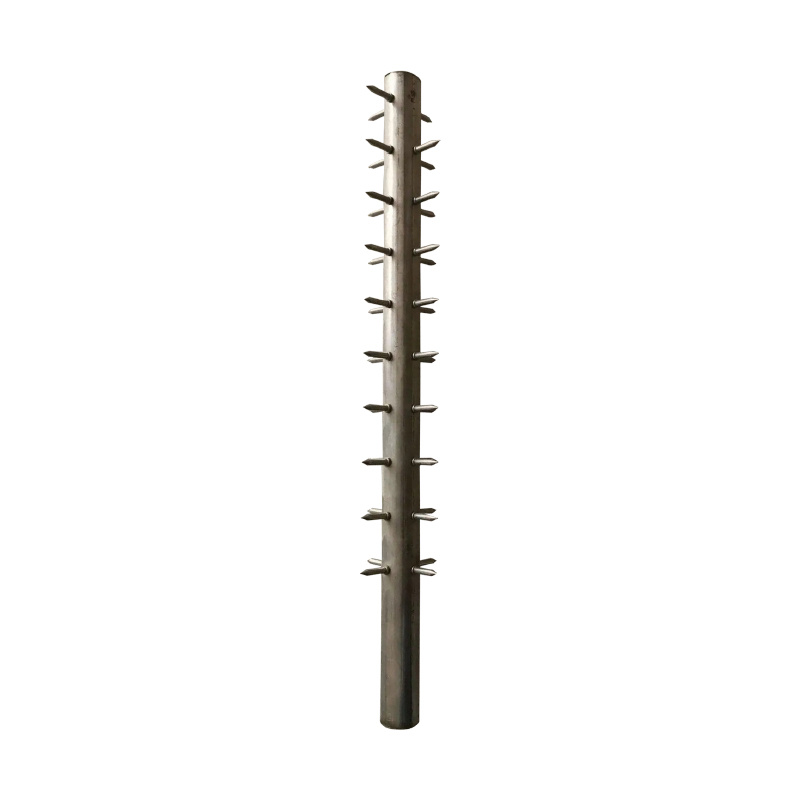
The barbed wire, also known as the corona electrode, together with the anode plate, forms a non-uniform electric field in the electrostatic precipitator. Through discharge at the tip, a corona current is generated, which charges the dust particles and captures them by the anode plate. Its discharge performance is closely related to the curvature of the tip. If there is dust accumulation, passivation, or problems such as wire breakage and deformation at the tip of the thorns, it will directly lead to a decrease in electric field strength, a weakening of corona current, and even cause electric field short circuits, resulting in a sudden drop in dust removal efficiency, excessive outlet emissions, and other consequences.
From the perspective of structural characteristics, a power supply zone of an electrostatic precipitator usually contains hundreds to thousands of barbed wires. The detachment or disconnection of a single barbed wire may cause the entire electric field to fail, thereby affecting the overall operating efficiency and accelerating the wear of induced draft fan blades, shortening the service life of the equipment. Therefore, the regular maintenance and upkeep of the barbed wire is not only necessary to ensure its own performance, but also the core link to maintain the stability of the electrostatic precipitator system and reduce operation and maintenance costs.
2、 Key points for daily maintenance and upkeep of barbed wire
The daily maintenance of barbed wire should revolve around "preventing dust accumulation, loosening, corrosion, and deformation", and establish a daily inspection and regular maintenance mechanism based on equipment operating conditions. The specific points are as follows:
(1) Core content of daily inspection
1. Monitoring of operating parameters: Daily real-time monitoring of secondary voltage and current data of the high-voltage power supply system. If there is a sudden drop in voltage, a sudden rise in current, or frequent fluctuations, it may be a warning signal of serious dust accumulation, looseness, or short circuit in the barbed wire, and it is necessary to stop the machine for inspection in a timely manner. Under normal operating conditions, the secondary voltage is usually maintained at 60-80kV, and the current is stable without obvious sawtooth fluctuations.
2. Inspection of the vibration system: The effective operation of the vibration device is the key to avoiding dust accumulation on the burrs. Daily check the operation status of the vibration motor, the tightness of the transmission tape, and the integrity of the protective cover to ensure that the vibration hammer is in normal contact with the barbed wire frame, without any jamming or detachment; At the same time, confirm that the lubricating oil level inside the vibration box is within the specified range and there are no abnormal noises when turning the belt pulley.
3. Insulation system protection: The barbed wire relies on high voltage electricity to generate corona, and the cleanliness and drying of insulation components are crucial. Daily inspection of the sealing condition of the insulator room is required to prevent contamination of the insulation components due to smoke leakage; In high humidity environments, it is necessary to ensure that the insulation chamber heat tracing device works normally, maintain an indoor temperature of 50-60 ℃, and avoid condensation and leakage.
(2) Regularly maintain key processes
1. Dust cleaning: According to the concentration of smoke dust, conduct a comprehensive dust cleaning of the barbed wire every 1-3 months. For dry electrostatic precipitators, dust accumulation can be removed by strengthening vibration or compressed air blowing; For wet electrostatic precipitators, it is necessary to check whether the spray system nozzle is blocked, ensure that the water film evenly covers the surface of the burr line, and avoid dust adhesion and scaling. After cleaning, it is necessary to confirm that there is no residual dust at the tip of the spikes to ensure the discharge effect.
2. Structural integrity testing: Conduct a comprehensive inspection of the barbed wire during quarterly shutdowns, with a focus on the following: ① Check the connection between the barbed wire and the cathode frame for any open welding, loose bolts, or detachment. If any problems are found, timely repair welding or tightening should be carried out, and the bolts should be spot welded and reinforced to prevent loosening during operation; ② If there is passivation, electrical corrosion, or chipping at the tip of the burr, it should be promptly polished and repaired. In severe cases, the entire burr wire should be replaced; ③ The overall shape of the barbed wire, if there is bending or deformation, needs to be corrected using specialized tools to ensure that the tension of the polar wire meets the design requirements (usually 80%~100% of the design value).
3. Pole spacing calibration: The uniformity of the spacing between the spike wire and the anode plate directly affects the distribution of the electric field. Every six months, a laser rangefinder should be used to calibrate the pole spacing to ensure a deviation of ≤± 3mm, in order to avoid local short circuits caused by too small spacing or a decrease in electric field strength caused by too large spacing. If the cathode frame is found to be offset, the levelness of the hanging point needs to be adjusted to restore the frame position.
4. Anti corrosion maintenance: For flue gas conditions containing corrosive gases such as SO ₂ and Cl ₂, it is necessary to check the corrosion of the burr line every quarter. If surface corrosion and thinning are found, PTFE anti-corrosion coating should be sprayed in a timely manner or replaced with corrosion-resistant material such as barbed wire; At the same time, anti-corrosion treatment should be carried out on the welding points to ensure that the shear force of the welding points is ≥ 0.6KN and there is no breakdown of the pipe wall.
3、 Common fault diagnosis and treatment of filigree wire
The burr line fault is one of the main causes of abnormal operation of electrostatic precipitators. The diagnosis and treatment methods for common faults are shown in the following table:
1. The burr wire falls off, the electric field short circuit/arc core causes: loose bolts or insufficient spot welding strength; The spiral line is stretched too long during installation; Surface damage leads to fracture. Solution: Stop the machine to clean the loose pole wire, re tighten or replace it with a new pole wire, and ensure that the installation tension meets the requirements; Strengthen the bolts by spot welding to avoid loosening again.
2. Loose and deformed burrs and severe dust accumulation. The core cause is that the fixing bolts are not securely spot welded; Excessive vibration intensity; High temperature smoke causes thermal deformation. Solution: Re tighten the bolts and perform spot welding; Adjust the vibration parameters to reduce the impact force; Correct the deformed pole lines and replace those that cannot be corrected; Control the flue gas temperature within the design range.
3. The passivation of the pointed edge and the decrease in dust removal efficiency are mainly caused by long-term operation leading to tip wear; Dust adhesion and scaling were not cleaned in a timely manner. Solution: Use specialized tools to polish the tip and restore its sharpness; Strengthen the frequency of dust cleaning; Optimize spray or vibration parameters.
4. offset of cathode frame and abnormal pole spacing. Core cause: non horizontal hanging points; Fluctuations in smoke pressure cause deformation of the frame. Solution: Adjust the levelness of the hanging point and correct the position of the frame; Check the distribution of flue gas flow, optimize the diversion device, and stabilize the flue gas pressure.
4、 Stable operation guarantee strategy of electrostatic precipitator based on maintenance of barbed wire
The long-term stable operation of electrostatic precipitators is a system engineering. In addition to targeted maintenance of the barbed wire, it is also necessary to achieve collaborative support between the barbed wire and other systems
1. Power supply system coordination: The stability of the high-voltage power supply system is the foundation for the normal discharge of barbed wire. Regularly check the oil level and insulation oil quality of high-voltage silicon rectifier transformers, and conduct an annual oil quality test; Overhaul the high-voltage control cabinet every six months, replace aging components, calibrate the overvoltage protection threshold (usually 1.1-1.2 times the rated voltage), and avoid damaging the barbed wire due to voltage surges.
2. Control of flue gas operating conditions: Fluctuations in flue gas parameters can exacerbate spiking faults. Real time monitoring of flue gas temperature, humidity, and dust resistance is required to control the temperature within the design range and avoid pole line deformation caused by high temperatures; By adding a flue gas conditioning device, the dust specific resistance is adjusted to a suitable range of 10 ⁴~10 ¹¹Ω· cm, reducing the impact on the discharge performance of the spike wire.
3. Construction of full cycle operation and maintenance system: Establish a full cycle operation and maintenance mechanism of "daily inspection regular maintenance fault warning". Daily recording of operating parameters and inspection results, forming a 'Static Dust Collector Operation Log'; Conduct comprehensive maintenance every quarter, with a focus on investigating the coordinated operation status of the barbed wire, vibration system, and insulation system; Real time data collection using IoT platforms, setting warning thresholds for voltage fluctuations, electrode corrosion rates, etc., to achieve early intervention of faults.
4. Verification after maintenance: After maintenance or replacement of the barbed wire, a no-load power up test should be conducted to check for short circuits, flashover, and other phenomena in the electric field; After confirming that the secondary voltage and current have returned to the normal range, it can be put into operation with load to ensure that the maintenance effect meets the standard.
As the core component for establishing the electric field of electrostatic precipitators, the maintenance quality of the barbed wire directly determines the dust removal efficiency and operational stability of the equipment. By implementing daily parameter monitoring, regular dust cleaning, structural integrity inspection, and precise fault handling, the service life of the barbed wire can be effectively extended, ensuring its continuous and stable discharge performance. At the same time, relying on the concept of collaborative operation and maintenance of the system, precise matching of the barbed wire with the power supply system and flue gas conditions can be achieved to build a long-term stable operation guarantee system for electrostatic precipitators, providing reliable support for industrial flue gas purification standards.
Hot Tags:


Contact Us
Tel:
WeChat:
WhatsApp:
E-mail:
Address:
338 National Road South, Longfengdian Village, Botou City, Hebei Province, China
JiuznTomine is expertly delivering technically complicated projects in markets & provides custom solutions for their customized need.


CONTACT INFO
Tel: +86 18531710311
WeChat: +86-18531710311
338 National Road South, Longfengdian Village, Botou City, Hebei Province, China