












Dust removal skeleton: the "ribs" and core support frame of the filter bag
May 09,2026

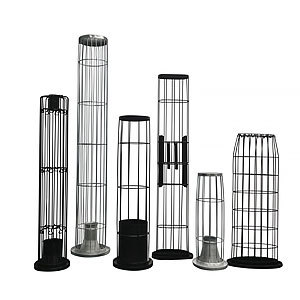
In the precise construction of bag filters, the dust removal skeleton (also known as the bag cage or filter bag frame), although seemingly ordinary, plays an indispensable role as the "skeleton". It is a cage shaped structural component welded vertically and horizontally by longitudinal bars and support rings, directly installed inside the filter bag. As a supporting frame for the filter bag, its quality directly determines the filtering state, operating resistance, and overall service life of the filter bag.
1、 Core function: Support, protect, and assist in cleaning dust
The dust removal framework is not just a simple metal cage, it plays three core functions in the dust removal system:
1. Support the filter bag to maintain its shape: During the operation and cleaning process of the bag filter, the filter bag will bear enormous gas pressure and mechanical stress. A sturdy skeleton can effectively counteract these external forces, preventing the filter bag from collapsing during filtration or excessively expanding and deforming during dust cleaning, ensuring that the filter bag always maintains the optimal filtration area.
2. Protect the filter bag from wear and tear: The high-quality skeleton surface is smooth, straight, and free of burrs. It can avoid direct friction between the filter bag and the dust collector housing or other hard objects, greatly reducing the risk of damage to the filter bag due to mechanical wear.
3. Assist in improving dust cleaning efficiency: Many dust removal skeletons are equipped with Venturi tubes at the top. At the moment of pulse cleaning, the Venturi tube can induce several times more secondary air to enter the filter bag, greatly enhancing the penetration and blowing effect of the airflow, making it easier for dust adhering to the surface of the filter bag to peel off.
2、 Common materials and surface treatment processes
In order to meet the temperature, humidity, and corrosion requirements under different working conditions, the dust removal skeleton has strict distinctions in material and surface treatment:
1. Carbon steel skeleton (surface galvanized/sprayed): This is the most common type, welded with high-quality low-carbon steel wire. By surface treatment processes such as cold galvanizing, hot-dip galvanizing, or electrostatic spraying, it is endowed with basic anti-corrosion ability. This type of skeleton has a lower cost and is suitable for normal working conditions at room temperature, dry, and without strong corrosiveness.
2. Organic silicon spraying skeleton: Spray a layer of organic silicon high-temperature resistant and anti-corrosion coating on the surface of carbon steel skeleton. This process not only has rust and corrosion resistance, but also can withstand high temperatures above 200 ℃. It has excellent comprehensive performance and is a cost-effective alternative to stainless steel skeletons. It is widely used in large-scale generator sets and dust collectors in the steel industry.
3. Stainless steel skeleton: Made of stainless steel wires such as 304, 304L, 316L, etc. It has excellent corrosion resistance, high temperature resistance, and oxidation resistance, especially suitable for harsh environments such as waste incineration, chemical, wet desulfurization, and food and medicine that require high hygiene or corrosion resistance.
3、 Structural design and selection considerations
The structural design of the dust removal skeleton directly affects its compatibility with the filter bag. When selecting, it is usually necessary to pay attention to the following key parameters:
1. Shape and specifications: In addition to the most common circular skeleton, there are also elliptical, trapezoidal, flat, and envelope shaped skeletons that are suitable for special spaces. Its diameter and length need to be precisely matched with the filter, and skeletons with a length exceeding 3 meters usually require a multi section plug-in design for easy transportation and installation.
2. Longitudinal bars and support rings: The number of longitudinal bars (usually 8, 10, 12, 16, or 24) and the spacing between support rings determine the overall stiffness of the skeleton. A reasonable distribution can ensure the support strength and avoid the increase of airflow resistance caused by overly dense ring reinforcement.
3. Processing accuracy: High quality skeleton requires all welding points to be firm, the surface to be smooth without burrs, and to have extremely high verticality. Any small flaw may scratch the filter bag during long-term vibration, leading to the failure of the dust removal system.
The importance of the dust removal skeleton as the "rib" of the filter bag is self-evident. A well-designed and well crafted dust removal framework can not only effectively extend the service life of filter bags by 20% to 30%, but also significantly reduce the operating resistance and maintenance costs of dust collectors. In the configuration of industrial dust removal systems, scientifically matching the skeleton and filter bag is the fundamental guarantee for achieving long-term stable and efficient operation of the equipment.
Hot Tags:
PREVIOUS:
Contact Us
Tel:
WeChat:
WhatsApp:
E-mail:
Address:
338 National Road South, Longfengdian Village, Botou City, Hebei Province, China
JiuznTomine is expertly delivering technically complicated projects in markets & provides custom solutions for their customized need.


CONTACT INFO
Tel: +86 18531710311
WeChat: +86-18531710311
338 National Road South, Longfengdian Village, Botou City, Hebei Province, China